

Reader's Comments
Check out what some readers have said about the book!
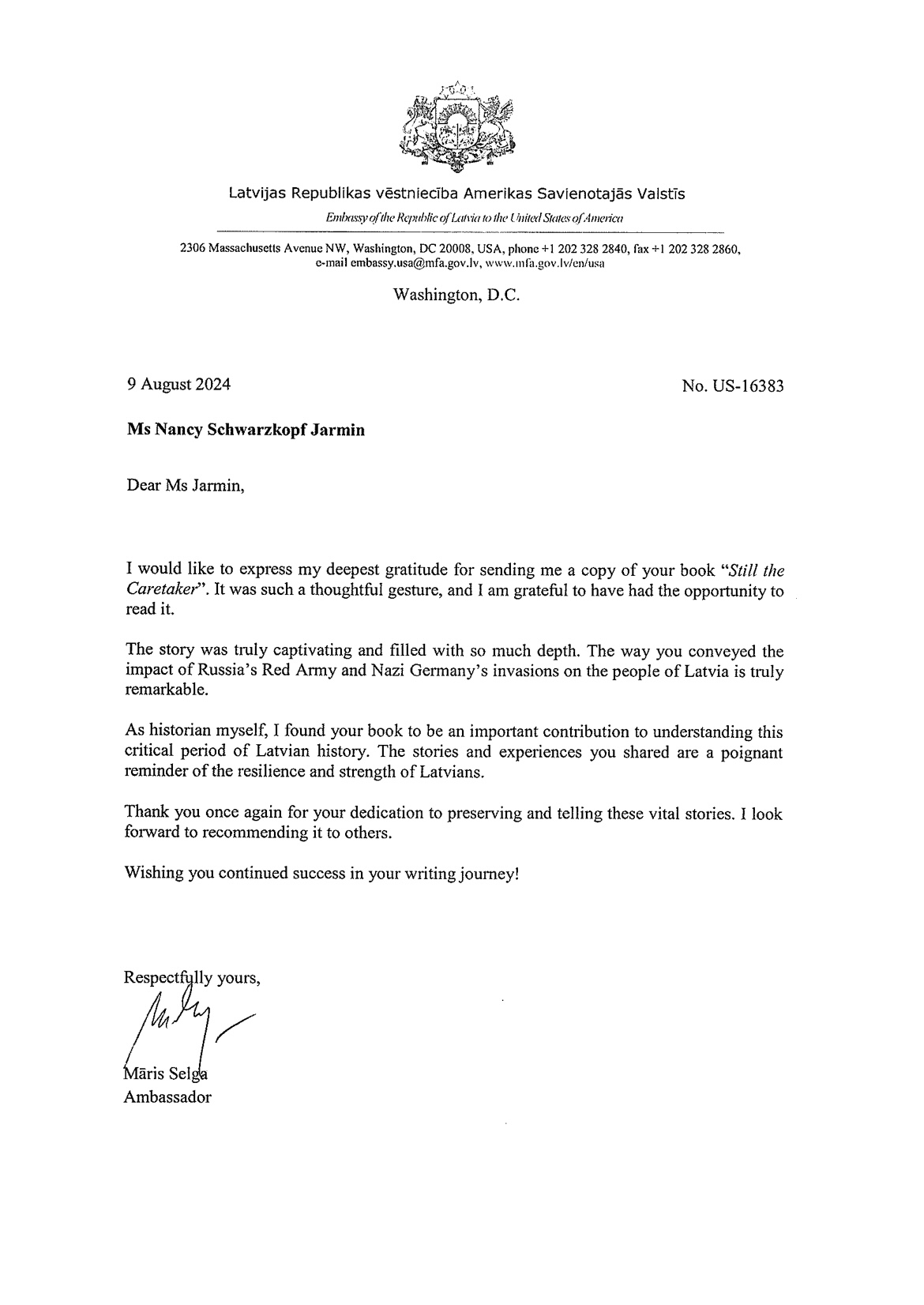
Other Comments:
“I always enjoy historical fiction; one can learn so much in a very entertaining way. In this case, as a Latvian, I can say that this book is an excellent view into lives during World War II in Latvia, it could be the story/experience of any of our families, well worth the read!”
Aina BerkisAmazon
“A thoroughly engaging story of civilians just trying to survive and preserve their way of life as World War II threatened to tear them all apart. I love the way it was told through the eyes of a girl just entering her teen years, living in the bosom of a loving extended family.”
AntyMAmazon
“By the 10th page I felt like I couldn’t put this book down. The character development engages you in the family, their fears and struggles and their constant hope. I found myself thinking about the characters even when I wasn’t reading the book. When I came to the end of the book I wanted even more. As a historical novel the research paid off in my understanding of the real heartache families suffered during the war. The author was able to describe events so you knew what happened; but you didn’t have to deal with graphic details. I highly recommend this book. You won’t be disappointed. It is one of the most engaging books I have read. The 400+ pages seemed to go by too quickly.”
D.R.H.Amazon
“This gem of a novel invites you to see the complex real-world events of non-Jewish refugees from Latvia, before and during WW2 through the eyes of a fictional child and her adult-self much later in life. The Latvians face occupation first by the Russians and then by the Germans, and eventually staying in their homes is too dangerous. From the narrator’s perspective as she grows through her preteen and early teen years, she must deal with fear and not a little anger as her parents, grandmother, aunts and uncles tell her and her cousins what they must do but not why. Especially difficult for her to understand are her father’s secretive work in the city that leads to long absences, her mother’s insistence that she leave her beloved pets behind when they must go, and her beloved teenage cousin’s conscription into the very army that is raiding their farms and kicking them out of their homes. Schwarzkopf-Jarmin gives us a meticulously researched historical novel that does not shy away from difficult history but charmingly uses point of view to tell a story that is honest without being overwhelming.”
D. OhlandtAmazon/Goodreads
“My favorite genre is historical fiction, and though much has been written about this time in history, I have not read must about this small country and their terrible and frightening experiences during WWII. So very important that we remember this time as I wish history would not continue to repeat itself. Such a good read for junior readers as well as adults. Well written and hard to put down. Reading this book reminds me of how many people live lives they have little control over and just want to live in peace. Thanks to the author for writing this book. I really appreciate the listing of the characters of the book at the front, so I was able to refer to each one as I read.”
Ruth VesberAmazon/Goodreads
“This gripping story of the Russian and German occupation is one I’ve never heard before. Nancy tells of the horror and violence experienced by the Latvian people through the eyes of a young girl. Zaiga’s story is a compelling read. I couldn’t put it down so driven by the need to know what happened next. Even more thrilling was knowing this is based on a true person, Dr. Zaiga Phillips. If you like historical fiction, this is a must read.”
OU WomanAmazon
“This is a wonderfully empathetic coming of age story of a girl growing up in Latvia during WW2. She loves and cares for animals and wants to become a veterinarian like her mother. The whole family and close relatives try to cope with first the Soviet, then the German occupation in wartime, with her trying to protect her beloved animals, whilst trying to understand the events of the day when adults are keeping lots of secrets to protect their children. When the Soviets again invade Latvia in the later stages of the war, the family is forced to flee and make some heartbreaking decisions about their animals. Highly recommended.”
Gaby LaudamsAmazon
“This well written and well researched book captured my interest and held it throughout. Based on the stories of real people and real events, it makes one aware of the devastation caused by war in the lives of normal families forced to flee their homes because of the violence.”
NoniGoodreads
“I bought and started to read “Still the Caretaker” a month ago and today, (now that my double cataract operation has made reading comfortable again) I finished it. I hesitate to overpraise it in my case words sound like a pompous admission of the author’s “accuracy” in capturing this part of my own history – paltry words of praise about the creation of truly moving fiction. The story is my story – my siblings, all dead now, were the age of Zaiga and Janis when World War II swept across their small country. I sailed that mine-riddled sea in utero. I benefitted from their love when I was corn – and woke my parents from nightmares about “the soldiers coming” long into my own teen years. But the story of this family is NOT my family’s – and because of the writing genius of Nancy Schwarzkopf Jarmin, it deserves to be read by everyone. As the world, 80 years later, votes to close its border to “illegals” and “migrants” and “terrorists”, Nancy entrances us, as Atticus Finch did, by knowing that, “You never really understand a person until you consider things from his point of view...until you climb into his skin and walk around in it.” We don’t just walk in Zaiga’s shoes in the book – we feel her emotions, her fears, her inner conflicts, and learn more about the refugees’ plight than our own parents were willing to tell us. Nancy Jarmin’s work is universal because it is grounded so deeply in the nature, the family connectedness, and the rituals and folk beliefs of this small Baltic country. Even if you’re not Latvian, Estonian or Lithuanian or...buy it and read it – PLEASE! Then pass it on to anyone who wonders how war destroys the lives of innocent precious non-combatants as well as soldiers.”
Enrique JantsAmazon
“We live in a world today where many in the West, especially North America, are not familiar with the horrors of war. Unfortunately, as long as evil, narcissistic power-mongers are in positions of power, war displacement and the necessity of entire communities abandoning their beloved homes are STILL a reality for far too many. The characters in Nancy’s incredibly believable WWII story could just as easily be Ukrainians fleeing Putin’s horrific, brutal invasion. I strongly recommend this book to parents and families to help children understand why people flee their homes and become refugees; why there might be new children in their classrooms from foreign lands who may be struggling to cope in new surroundings; how refugees at our borders are NOT the enemy – the heartless criminals running corrupt government who forced them to leave their home for safety and survival ARE. This book will help parents educate children (and themselves) about the horrors of war and displacement without graphic details or scary imagery. It also has the potential to generate conversation about what they would do, where they would go, how to prepare for anything that might cause a family’s personal displacement (tornado, hurricane, an earthquake, a fire, etc.) I could not put this page-turner down. Incredible storytelling. ”
“Customer”Amazon
